Time Words for Kids Vocabulary and Activities

Time words name when something happens, its duration, and its sequence. Time Words for Kids: Vocabulary and Activities should cover more than dial numbers. Children need words such as today, later, before, always, and minute. Start with your child’s routine. A five-year-old can order picture cards; an older child can compare schedules or plan a week. The goal: understand a time question and answer clearly.
📥 My Time Words Practice Pack
Read, match, write, and build confident sentences about routines and time.
Leave your email — we'll send the PDF to your inbox.No spam — the PDF plus one short reminder. Unsubscribe anytime.
Core Words and Phrases
Teach five core groups: telling the time, calendar time, sequence, frequency, and duration. These groups present time vocabulary as a system. Introduce words from each group, then repeat them in speech, reading, and play.
Clock phrases include o’clock, half past, quarter past, quarter to, noon, and midnight. Calendar words include today, tomorrow, yesterday, weekday, and weekend. Teach the units second, minute, hour, day, week, month, and year.
Children can use sequence words before reading a clock. Teach first, next, then, later, before, after, early, late, and soon. A balanced Time Words for Kids: Vocabulary and Activities lesson pairs these words with spoken times and calendar language.
Using Time Vocabulary in Context
Teach each word in a sentence. In Time Words for Kids: Vocabulary and Activities, examples should fit adaptable routines: “I wake up at seven,” “We eat after the lesson,” “The game lasts for twenty minutes,” and “I visit my grandparents on Sunday.” Match the details to your child’s life.
Questions activate vocabulary. Ask, “What do you do before breakfast?”, “When is your English lesson?”, “How long does the lesson last?”, or “What will you do tomorrow?” Accept a short answer, then expand it: “At six” becomes “I have dinner at six.”
Time words support storytelling: “First, the dragon wakes up. Next, it looks for food. Later, it goes home.” Across LearnLink lessons, our tutors can adapt sequence practice to a child’s level and interests.
For children, use a three-column “past, present, future” strip. Give the child nine event cards, such as breakfast, school, and bedtime, and ask them to place three cards in each column. Then prompt complete sentences: “Yesterday I played,” “Today I am playing,” and “Tomorrow I will play.” Repeat with morning, afternoon, and evening to connect tense with parts of the day.
Watch for confusing “at,” “on,” and “in,” a common mistake. Teach the pattern through sorting: clock times go with “at,” days and dates with “on,” and months, years, and parts of the day with “in.” Read six phrases aloud, including “at five,” “on Monday,” and “in July,” and let the child correct one deliberately wrong example. Finish with a 60-second challenge using at least four time words.
Activities for Different Ages
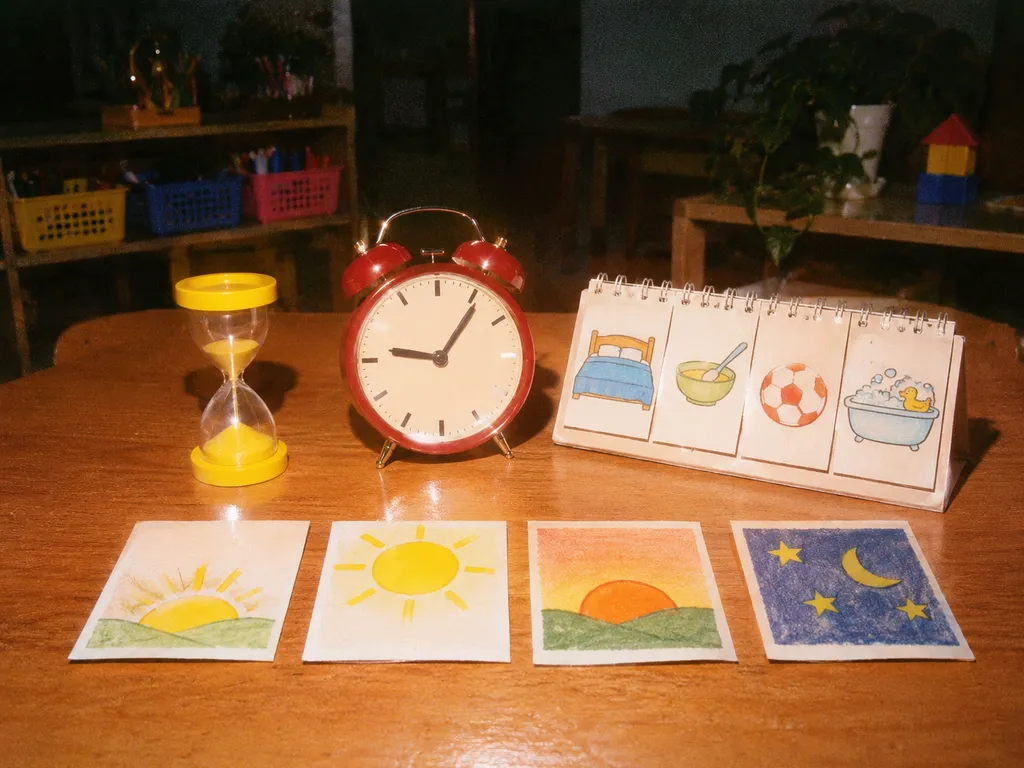
For school-age kids, combine movement and pictures. Place three routine cards on the floor. Ask your child to stand beside the activity that happens first, next, or last. A toy dial can introduce whole hours. Clock reading need not precede words such as morning, later, and after.
For school-age kids, create a daily timeline with waking, meals, lessons, play, and bedtime. Describe the order aloud, then play a guessing game: “It happens after lunch but before dinner.” The other player names the activity and its time.
For school-age kids, set purposeful planning tasks. Arrange a family day, compare two timetables, or find a shared time for an online activity. Older learners can explain changes: “The film starts later than the game,” or “We moved the lesson from Tuesday to Thursday.”
Simple Ways to Practise
Practise Time Words for Kids: Vocabulary and Activities for five to ten minutes. During breakfast or the trip to school, ask two time questions. Repetition across the week is easier than presenting every word at once.
Time Detective Challenge
Choose three activities from your child’s day. Give time clues: “This happens before lunch,” “This lasts for thirty minutes,” and “This usually happens in the evening.” Your child identifies each activity, then creates three clues. Encourage full answers or offer a sentence starter: “It happens…” or “It lasts…”
Set a toy dial and ask for the time, sort cards into past, present, and future, or reorder mixed-up instructions. Songs and stories work when you identify the target words and reuse them afterwards.
For children aged six to nine, make a seven-card timeline with wake up, breakfast, school, lunch, play, dinner, and bedtime. Ask the child to place the cards in order and describe four steps using first, then, before, after, and finally. If they hesitate, model one sentence, then remove the model and repeat the sequence with two cards swapped.
Watch for the common mistake “in Monday” or “at the morning.” Use a three-column sorting sheet: at for clock times, on for days, and in for parts of the day. Read nine phrases aloud, three per column, and let your child move a counter to the correct heading. Finish with three personal questions, such as “What do you do at seven o’clock?” Recast short answers as complete sentences.
Common Mistakes and Helpful Corrections
Children may confuse before and after. Demonstrate the order with two objects. Put a cup before a book and say, “The cup is before the book.” Swap them, repeat the sentence, then connect the pattern to daily events.
Prepositions need direct practice. English uses at with an exact time, on with a day, and in with parts of the day: “at five,” “on Monday,” and “in the morning.” The exception is “at night.” Keep a rule-and-example card nearby.
Do not present one family schedule as standard. Meal times, school days, weekends, and time formats vary across countries and homes. Teach the English form through your child’s routine. If your child uses a 24-hour clock, connect 18:00 with “six in the evening” without replacing the familiar system.
When a word has several meanings or pronunciations, Cambridge Dictionary is a useful check before turning it into child-friendly examples.
Frequently Asked Questions
These questions help you choose a starting point and keep practice focused.
What Time Words Should My Child Learn First?
Start with daily words: now, later, today, tomorrow, before, after, morning, and night. Add whole-hour phrases such as “at seven” when your child is ready. Time Words for Kids: Vocabulary and Activities connects each word to a familiar action, picture, or question.
Can My Child Learn Time Words Before Telling the Time?
Yes. Children can understand sequence, frequency, and parts of the day without reading an analogue clock. Use picture routines to practise first, next, sometimes, and every day. Clock reading can develop alongside phrases such as “We play after lunch” or “The lesson is tomorrow.”
Should Our Tutors Teach 12-hour or 24-hour Time?
Begin with the format your child sees at home, school, and on local devices. Present the other format as a connection, not a correction. Place “18:00” beside “6:00 p.m.” and say both aloud. Context words such as morning and evening clarify spoken times.
How Often Should My Child Practise Time Vocabulary?
Practise briefly across the week. Ask one or two questions during real activities: “What happens next?”, “What time does it start?”, or “How long will it take?” Repeat the words until your child understands and says them without a model. Then add two or three new items while revisiting older vocabulary.
Start your child's English journey today — book a trial lesson with LearnLink.
Stay updated on our latest tips and resources by following us on Instagram LearnLink.